

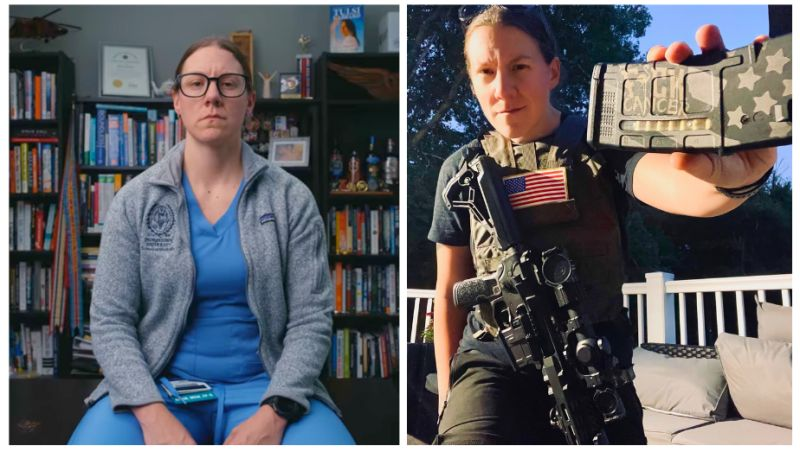
Imagine witnessing the aftermath of gun violence firsthand—countless wounds, the lifeblood spilled, and the struggle between life and death. Now imagine that same person choosing to carry a firearm, not out of fear, but empowerment and principle. This paradox challenges common assumptions about gun ownership, revealing profound truths about reason, force, and civilization.
The Trauma Provider’s Paradox: Guns and Healing
Chelsey Simoni, a seasoned trauma provider, has spent 2,517 days on the frontlines of trauma care. Her daily reality is one of blood-soaked shoes—six pairs discarded so far—and countless sets of scrubs worn thin by the relentless cycle of treating gunshot wounds. Her experience is a stark reminder of the physical and emotional toll that gun violence inflicts not only on victims but also on those who dedicate their lives to saving them.
Simoni’s role in trauma care has exposed her to every conceivable scenario involving firearms: accidental discharges, intentional shootings, self-inflicted injuries, and a wide range of calibers and outcomes. She has witnessed the loss of limbs, the loss of life, and, on rare occasions, miraculous survivals that defy the odds. The personal trauma of these experiences is profound, shaping her perspective on both violence and healing.
Personal Trauma and Professional Duty
The daily exposure to severe firearm injuries leaves an indelible mark on trauma providers. For Simoni, each case is not just a medical challenge but a deeply personal event. The emotional weight of treating victims—sometimes children, sometimes friends or neighbors—adds layers of complexity to her work. The trauma is not only physical but psychological, affecting both patient and provider.
Despite this, Simoni’s stance on gun ownership surprises many. She is open about being a lawful gun owner, a fact that often meets with confusion or disbelief. The assumption is that someone who has seen the worst consequences of firearms would naturally oppose their presence in society. Yet, Simoni’s perspective is more nuanced, shaped by her direct experience and a deep understanding of the realities of violence.
The Why About Being a Gun Owner
Simoni’s openness about her lawful gun ownership challenges common stereotypes. She references a well-known essay, “The Gun is Civilization” by Maj. L. Caudill, Ret. USMC, to explain her position:
“Human beings only have two ways to deal with one another: reason and force. If you want me to do something for you, you have a choice of either convincing me via argument, or force me to do your bidding under threat of force. Every human interaction falls into one of those two categories, without exception. Reason or force, that’s it.”
For Simoni, the personal firearm is not a symbol of aggression, but of equality and self-determination. She emphasizes that carrying a gun is not about seeking conflict, but about ensuring that force is removed from the equation. In her words:
“When I carry a gun, you cannot deal with me by force. You have to use reason and try to persuade me, because I have a way to negate your threat or employment of force.”
Trauma Care, Gun Owners, and the Balance of Power
Simoni’s perspective highlights a key point in the debate over firearms: high personal exposure to gun violence does not necessarily correlate with opposition to gun ownership. In fact, those who have witnessed the devastating effects of violence may have a deeper appreciation for the importance of self-defense and the ability to protect oneself and others.
- Personal Trauma: Direct experience with gun violence shapes, but does not dictate, attitudes toward firearms.
- Trauma Care: Providers like Simoni see the consequences of force, yet recognize the role of personal firearms in leveling the playing field.
- Gun Owners: Lawful gun ownership can coexist with a commitment to healing and saving lives.
Simoni’s dual identity as a trauma provider and gun owner underscores the complexity of the issue. She does not carry a firearm out of fear, but out of a desire to be unafraid and to ensure that her interactions with others are governed by reason, not force. Her experience in trauma care informs her belief that the presence of a firearm can deter violence and protect the vulnerable, rather than escalate conflict.
This paradox—healing the wounds caused by firearms while advocating for the right to carry them—offers a unique and often overlooked perspective in the ongoing conversation about guns in society. Simoni’s story is a powerful reminder that the relationship between trauma, healing, and gun ownership is far more nuanced than it may appear.
The Gun as an Equalizer in Physical Confrontations
A key insight from both Simoni’s experience and Caudill’s analysis is the paradoxical role of firearms in society. While often viewed as instruments of violence, guns can also serve as powerful deterrents against the misuse of force. When a law-abiding individual carries a firearm, the balance of power in any potential confrontation shifts dramatically.
- A firearm can put a 100-pound woman on equal footing with a 220-pound attacker.
- An elderly retiree is no longer at a disadvantage against a younger, stronger assailant.
- A lone individual can stand their ground against multiple aggressors.
This ability to balance disparities in physical power is central to the argument for responsible gun ownership. The presence of a firearm does not escalate conflict; rather, it discourages the use of force by making it a less viable option for would-be aggressors.
Promoting Civil Interaction Through Deterrence
The presence of a firearm fundamentally changes the nature of social exchanges. When it is known that individuals may be armed, the incentive to use force diminishes. Interactions are more likely to be resolved through reason, as the threat of violence is neutralized by the possibility of an effective defense.
This is not about seeking confrontation. As Simoni notes, most lawful gun owners carry not out of fear or aggression, but out of a desire to be left alone and to ensure their safety. The firearm at their side is not an invitation to violence, but a statement that force will not be tolerated as a method of interaction. When the threat of physical dominance is neutralized, individuals are compelled to rely on reason and persuasion. In this way, carrying a firearm becomes not just a personal choice, but a civilized act—one that upholds the values of equality, respect, and peaceful coexistence.
Dispelling Myths: Guns as Instruments of Peace, Not Chaos
The debate over gun ownership in modern society is often clouded by fear and misunderstanding. Many people assume that the presence of firearms inevitably leads to more gun violence, chaos, and aggression. However, the lived experiences of responsible gun owners and the insights of trauma professionals like Chelsey Simoni challenge these assumptions and reframe the role of guns in society—not as tools of destruction, but as instruments of peace and personal safety.
Simoni’s reflections, shared widely in the gun owner community, highlight a necessary distinction: the difference between the misuse of firearms and their legitimate, lawful use for self-defense. Despite witnessing the tragic consequences of gun violence, Simoni remains a committed and responsible gun owner. Her stance is not rooted in aggression or a desire for conflict, but in a fundamental belief in personal freedom and security.
At the heart of this argument is the idea that human beings interact through either reason or force. In a truly moral and civilized society, reason and persuasion should be the only acceptable means of interaction. Unfortunately, the reality is that not everyone abides by these principles. When force is threatened or used, it is the personal firearm that enables individuals—regardless of age, gender, or physical strength—to defend themselves and demand that others interact with them through reason, not violence.
This concept directly challenges the common misconception that guns always escalate violence. In fact, research and real-world examples suggest that responsible firearm ownership can deter armed crime and reduce victimization. When law-abiding citizens are equipped to defend themselves, potential aggressors are less likely to use force, knowing that their intended victims are not defenseless. This deterrent effect is not theoretical; it is supported by studies and crime statistics from regions with higher rates of lawful gun ownership, where armed citizens have successfully prevented crimes and protected themselves and others.
For many gun owners, carrying a firearm is not about seeking confrontation. As Simoni explains, it is about being left alone—to live in peace without fear of being overpowered by those who would use force. The gun at their side is not a symbol of aggression, but of empowerment and self-reliance. It does not limit the actions of those who interact through reason, but it does act as a check on those who would resort to violence. In this way, responsible gun ownership fosters a sense of personal safety and psychological freedom, reducing fear and anxiety in daily life.
Opponents of civilian gun ownership often argue that removing guns from society would make everyone safer. However, this view overlooks the reality that criminals and aggressors are unlikely to disarm themselves simply because laws change. Disarming law-abiding citizens only serves to tip the balance of power in favor of those willing to break the law. As Simoni and many others have observed, the presence of a firearm in the hands of a responsible citizen is not a threat to public safety, but a safeguard against those who would use force to harm others.
In conclusion, the narrative that guns are inherently instruments of chaos fails to account for the experiences of responsible gun owners and the deterrent effect of lawful firearm possession. Carrying a gun is not about seeking violence, but about ensuring personal safety and the freedom to live without fear. As society continues to grapple with questions of gun violence and public safety, it is essential to recognize that, in the right hands, firearms can serve as powerful tools for peace and civilization.
TL;DR: Carrying a gun is not about seeking conflict but about restoring balance between reason and force in human interactions, enabling personal safety and societal civility.